Back to archivecertified generic

Case file

anonisor.com

ShitScore 85 / 100SaaSCaptured 2026-05-17Submitted by communityVisit crime scene ↗

An enterprise privacy-verification layer whose core feature list includes a "Coming Soon" badge, whose regulatory compliance is described as "friendly," and whose solution to misinformation, whistleblower suppression, and platform credibility loss is a single sentence: "Anonisor fixes this."

Anonisor sells anonymous employment verification as enterprise trust infrastructure. The editorial section lists three serious social problems — misinformation, research failure, and silenced whistleblowers — and resolves them with the sentence "Anonisor fixes this." The core feature list has a Coming Soon badge on its third item. The security section describes GDPR and SOC 2 alignment as "friendly." The use case grid fills its sixth slot with "Your Platform," which is not a use case but an invitation to imagine one. The only customer evidence is: "Early pilots underway with enterprise & high traffic platforms."

Share this roast

PostShare

Exhibit A — Evidence

Captured 2026-05-17

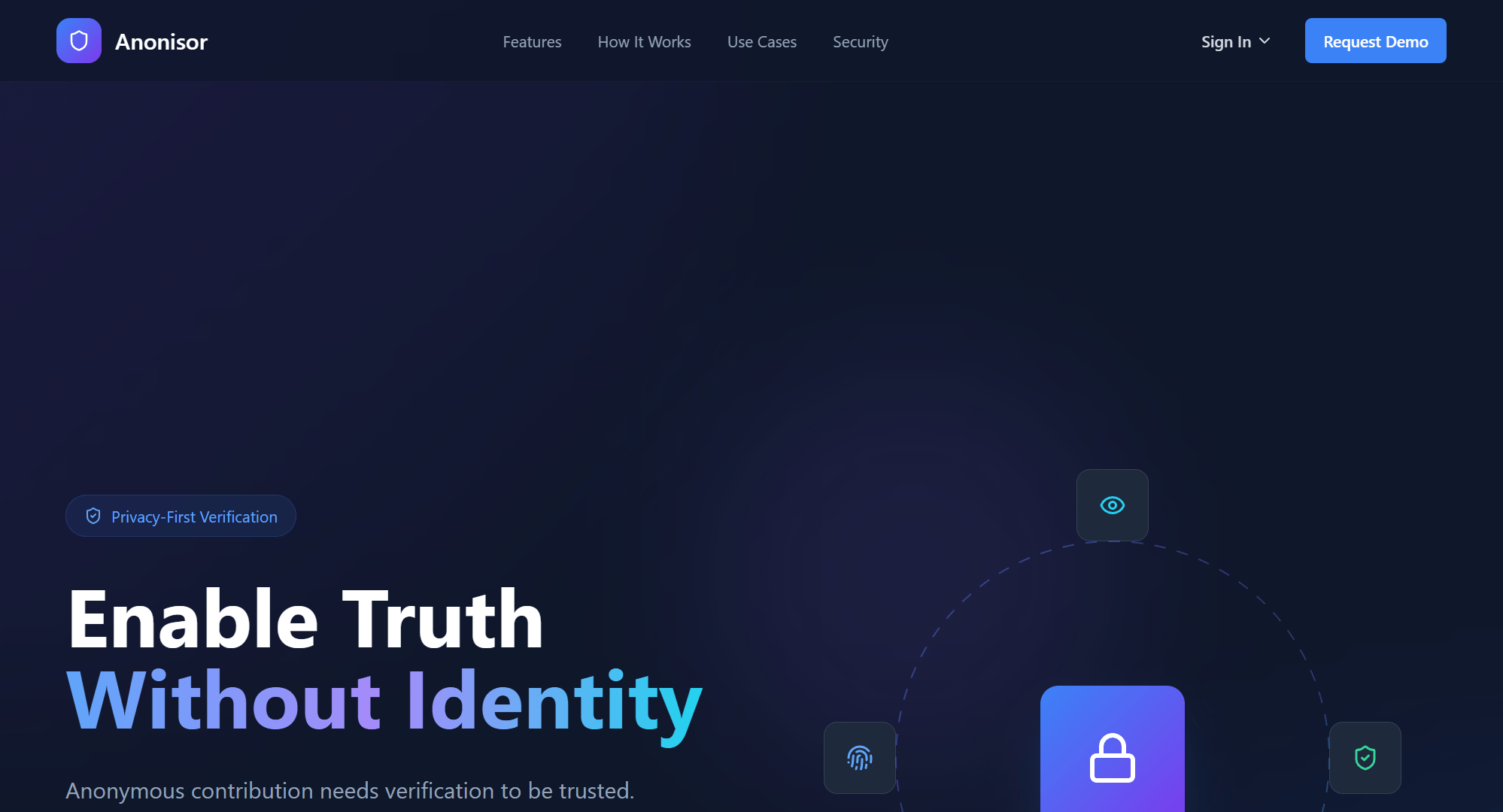
Hero viewport of anonisor.com on a deep navy background. Top-left: "Anonisor" logo with a teal circular icon. Nav: Features, How It Works, Use Cases, Security. Right: Sign In dropdown and a purple "Request Demo" button. A "Privacy-first Verification" chip badge in teal. Left: large headline "Enable Truth" in white, "Without Identity" in teal/cyan. Subtext: "Anonymous contribution needs verification to be trusted. Anonisor makes anonymity safe, credible, and useful." Two CTAs: "Request Demo →" in purple and "For Platforms & Teams" in outline. Three trust chips: Privacy preserving, Zero PII exposed, Easy integration. Right side: abstract node-graph graphic with a purple lock icon in the centre and eye icons at the nodes, suggesting privacy-aware data flow.
Screenshot — anonisor.com (1998×1080)

Score breakdown

Prompt residue9/10
Feature grid density8/10
Meaningless value prop9/10
Trust signal suspicion10/10
Founder face AI probability2/10
Product proof absence10/10
ShipFast resemblance9/10
Hero claim
Enable Truth Without Identity — "Anonymous contribution needs verification to be trusted. Anonisor makes anonymity safe, credible, and useful." Trust chips: Privacy preserving, Zero PII exposed, Easy integration.
Proof problem
"Early pilots underway with enterprise & high traffic platforms" — no customer names, logos, quotes, or case studies anywhere on the page. The only use case card with a real customer name is "Your Platform" (the reader). "Coming Soon" badge on Role & Claims Enforcement, one of three named core features. "GDPR & SOC 2 friendly design" — not compliant, not certified. No pricing page visible. "Request Demo" as primary CTA implies the product is not self-serve — the conversion funnel ends at a form submission. No documentation link resolves to a public page. No mention of active customer count, API call volume, or any quantified proof of scale.
Visual pattern
Deep navy background → teal/cyan logo + "Privacy-first Verification" chip → large white/cyan headline "Enable Truth Without Identity" → subtext + purple "Request Demo →" + outline "For Platforms & Teams" CTAs → trust chips → abstract node-graph hero graphic with purple lock → full-width editorial paragraph → "What Anonisor Solves" 4-icon card grid → "The Privacy-Preserving Verification Layer" 4-item feature list with status badges (Core Feature, Available, Coming Soon) → "Built for Platforms" 6-icon logo row → "How It Works" 3-step → "Enterprise-Grade Privacy & Security" bullet list + code snippet → "Where Anonisor Is Used" 6-card use case grid → rounded-corner CTA banner "Upgrade Your Platform's Trust Layer" → footer.
Why it still might convert
The core problem is real and underserved: platforms that want high-quality anonymous contributions (whistleblowing tools, salary benchmarking, workplace reviews) genuinely need a way to verify that the anonymous person is who they claim to be without collecting PII. The cryptographic token approach is a legitimate technical architecture for this. If the employment verification feature works as described, it solves a problem that no major platform has cleanly solved. The "Request Demo" funnel is the right conversion mechanism for this buyer (enterprise platform) and the ask is appropriate for the product.

Editorial roast

By Editorial Desk · Filed against anonisor.com

¶ 01

"The Internet Needs Anonymity — But It Also Needs Trust." The editorial paragraph that follows is the strongest writing on the page: anonymity gives people safety, freedom, and courage; without verification, anonymous environments become noisy, unreliable, and easily abused; misinformation spreads; research becomes useless; whistleblowers go unheard; platforms lose credibility; users lose trust. These are genuine, documented problems with pseudonymous online spaces. The paragraph ends with a line break and then, in bold: "Anonisor fixes this." Three paragraphs. Four social problems. One product. The claim is so compressed that it ceases to function as marketing and [redacted] begins to function as a punchline. Misinformation: fixed. Research integrity: fixed. Whistleblower protection: fixed. Platform credibility: fixed. The word "this" is doing an extraordinary amount of work for a product whose core feature list is not yet complete.

¶ 02

The "Privacy-Preserving Verification Layer" section lists three verification modes: Anonymous Employment Verification (Core Feature), Domain & Affiliation Validation (Available), and Role & Claims Enforcement (Coming Soon). One of the three named capabilities of the product that is being sold to enterprise platforms does not exist yet. The Coming Soon badge appears on a feature that would let the platform verify whether a user's claimed role — employee, researcher, senior engineer, moderator — is accurate without surfacing their identity. This is not a minor roadmap item. It is the mechanism by which a platform would trust that the anonymous person claiming to be a senior director is, in fact, a senior director. The product is pitching enterprise trust infrastructure with an unfinished trust infrastructure.

An enterprise privacy-verification layer whose core feature list includes a "Coming Soon" badge, whose regulatory compliance is described as "friendly," and whose solution to misinformation, whistleblower suppression, and platform credibility loss is a single sentence: "Anonisor fixes this."

¶ 03

The security section is called "Enterprise-Grade Privacy & Security" and lists five trust signals: Zero PII shared with partner platforms, Hashed email internal retention, Tamper-resistant token architecture, GDPR & SOC 2 friendly design, and Easy to integrate API & SDKs. The fourth item is "GDPR & SOC 2 friendly design." Not GDPR compliant. Not SOC 2 certified. Friendly. The product that describes itself as "enterprise-grade" and "built from the ground up with privacy and security as core principles, not afterthoughts" uses the word "friendly" to characterise its relationship with the two most significant enterprise data-handling frameworks. GDPR friendly is the compliance equivalent of describing a fire extinguisher as "flame-adjacent." SOC 2 is an audit. It either passes or it does not. Friendliness is not an audit outcome.

¶ 04

"Where Anonisor Is Used" presents six use cases: Verified Anonymous Feedback, Verified Research Participants, Whistleblowing & Incident Reporting, Compensation & Review Platforms, Closed Communities, and — as the sixth card — "Your Platform: Bring verified trust to any anonymous experience." Your Platform is not a use case. It is a prompt for the reader to generate their own use case. The product has padded a six-slot evidence grid with the reader's imagination and presented it as deployment evidence. Beneath the grid: "Early pilots underway with enterprise & high traffic platforms." No names. No logos. No quotes. No case studies. The only customer evidence on an enterprise B2B page is a sentence asserting that customers exist and are large. The sentence is asking you to trust it the same way the product asks platforms to trust anonymous users: without revealing who they are.

— 30 —

More from the archive

Similar offenders on file.

supadrop.hostSaaSSS 62

A portfolio hosting product that says "30 seconds" twice in two consecutive section headings, positions its customers as "people, not developers" in a product named Supa-drop-.host, offers "beautiful templates" with beauty as the only descriptor, and closes with a footer asking if you are ready to use a product that, by its own repeated count, takes 30 seconds.

Open file →
latenode.comSaaSSS 75

An AI workflow automation tool whose hero defines itself as "automation that works" (implying competitors do not), whose value proposition is "intelligent automation — without the manual work" (the definition of automation), whose Zapier comparison claims to be "1k+ cheaper" without specifying the unit, and whose integration count of 6,000+ appears in at least two separate section headings on the same page.

Open file →
imperfectly.appSaaSSS 65

An anti-AI-slop writing tool — packaged in a hero / feature-cards / pull-quote / pricing-table / FAQ SaaS template that any AI would generate unprompted, decorated with a typewriter stock photo to signal authenticity, whose product logic is: AI writes too perfectly, so pay $9 a month to add the imperfections back.

Open file →

Correction channel

Wrong, unfair, or outdated?

Ask for a correction or update. Satire is more effective when the facts are not lazy.