Back to archivecertified generic

Case file

feather.so

ShitScore 60 / 100SaaSCaptured 2026-05-17Submitted by communityVisit crime scene ↗AFF.

A Notion-to-blog publishing tool that promises to turn your note-taking app into "a long-term organic growth engine," covers SEO with "We take care of the rest," and names its testimonial section "Our growing wall of love ❤️."

Feather publishes Notion pages as SEO-optimized blog posts. The headline: "Turn Notion into a long-term organic growth engine." The SEO feature copy: "All you have to do is write good content... We take care of the rest." The primary feature description ends with "it's just set and forget!" The testimonial section is titled "Our growing wall of love ❤️."

Share this roast

PostShare

Exhibit A — Evidence

Captured 2026-05-17

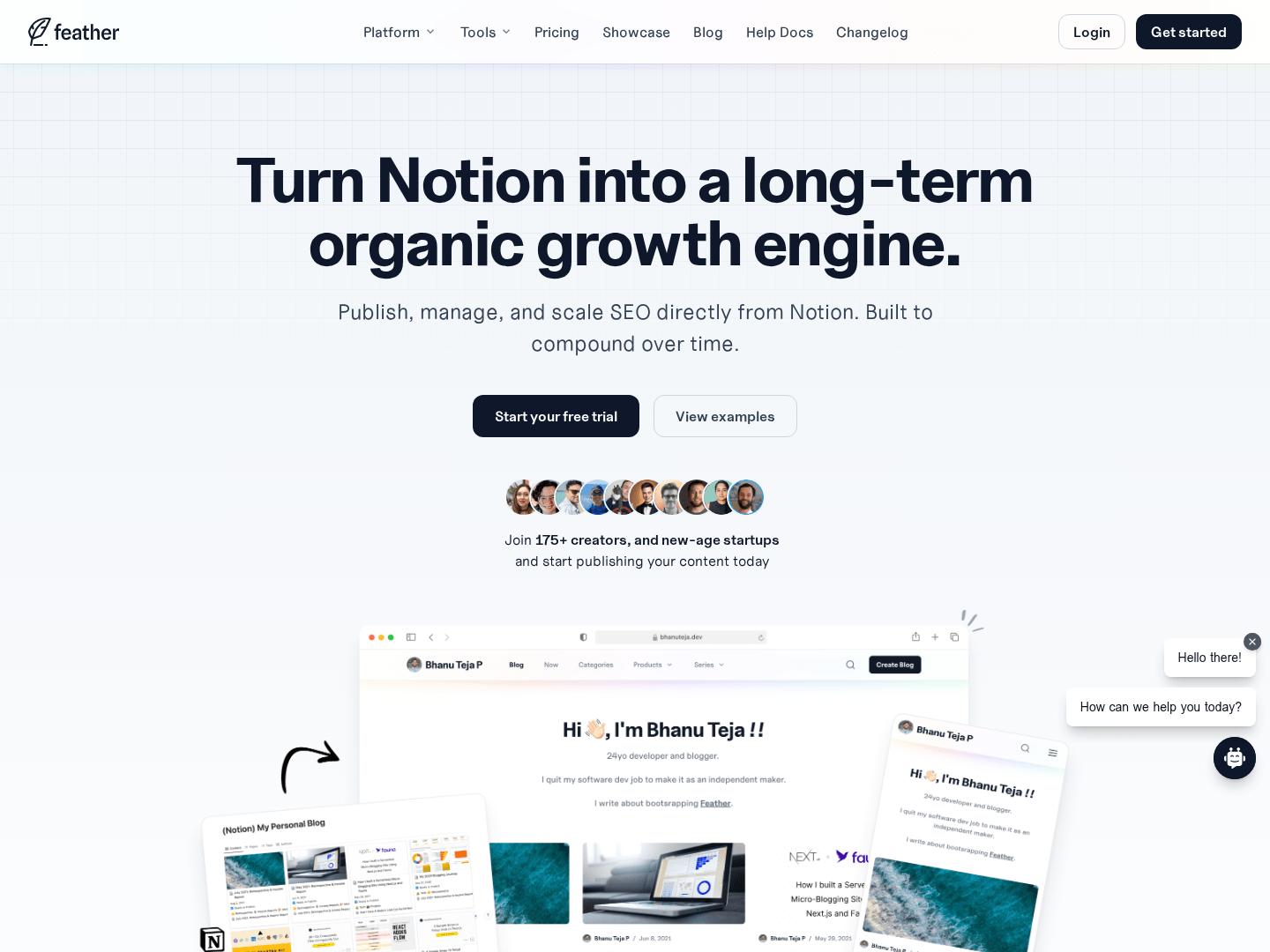
Hero viewport of feather.so on a white background. Top nav: Feather logo, Platform, Tools, Pricing, Showcase, Blog, Help Docs, Changelog, Login and Get Started buttons. Large black headline: "Turn Notion into a long-term organic growth engine." Subheadline: "Publish, manage, and scale SEO directly from Notion. Built to convert." Dark CTA button: "Start your free trial." Text link: "View examples." Social proof: "Join 674 websites..." A product screenshot shows a Notion-like editor interface with a blog post and a chat widget sidebar. Trust strip: "Trusted by 500+ startups" with logos including Tweet Hunter, Testimonial, xumm, GrowthX, Reflect, SwipeWell, BEYONK, Taplio, Dash MY, BotShot.
Screenshot — feather.so (1440×1080)

Score breakdown

Prompt residue6/10
Feature grid density7/10
Meaningless value prop8/10
Trust signal suspicion5/10
Founder face AI probability3/10
Product proof absence4/10
ShipFast resemblance9/10
Hero claim
"Turn Notion into a long-term organic growth engine." Subheadline: "Publish, manage, and scale SEO directly from Notion. Built to convert."
Proof problem
"Trusted by 500+ startups" with real logos (Tweet Hunter, Taplio are well-known). Real case studies: UX Playbook (8k+ monthly page views), Unplugged Rest. "Latest sites powered by Feather" shows real URLs. Product appears functional. The offense is value prop inflation: "organic growth engine" for a publishing layer; "we take care of the rest" for half of SEO; "set and forget!" in primary copy; "wall of love ❤️" as canonical ShipFast-era pattern.
Visual pattern
White background, clean minimal layout. Large black headline. Dark CTA. Product screenshot of Notion-style editor. Trust strip with startup logos. Five feature sections. "How Teams use Feather" case studies. "Everything you need to build a blog" 10-feature icon grid. 4-step process. "Our growing wall of love ❤️" testimonial grid. "Latest sites powered by Feather" showcase. Dark bottom CTA. Newsletter upsell.
Why it still might convert
Feather solves a real workflow problem for teams already in Notion. The zero-switching-cost pitch eliminates a genuine objection. Real case studies with page-view numbers are credible. Tweet Hunter and Taplio in the trust strip are recognizable to the indie SaaS audience it targets. It converts well because it solves an actual problem for a defined audience.

Editorial roast

By Editorial Desk · Filed against feather.so

¶ 01

"Turn Notion into a long-term organic growth engine." Feather is a publishing layer: it takes content written in Notion and outputs it as blog posts with correct meta tags and schema. A long-term organic growth engine requires content strategy, keyword targeting, consistent publishing cadence, backlink acquisition, topic authority, and audience development. Feather provides one of those inputs. The headline claims the outcome of all of them.

¶ 02

"All you have to do is write good content that satisfies the search queries of your readers. We take care of the rest." That is the SEO feature description. What Feather takes care of: meta tags, Schema markup, [redacted] edge serving, and SEO setting controls. What the rest of SEO actually contains: keyword research, backlink building, domain authority, crawl budget, indexing, content gaps, Core Web Vitals, and internal linking strategy. The sentence covers the publishing checklist and calls it the remainder.

A Notion-to-blog publishing tool that promises to turn your note-taking app into "a long-term organic growth engine," covers SEO with "We take care of the rest," and names its testimonial section "Our growing wall of love ❤️."

¶ 03

"Feather is a simple yet powerful platform that helps create a Superfast blog with Notion as a layer — it's just set and forget!" That exclamation mark is in the primary feature description, not in a testimonial or a tagline. The marketing copy for a tool positioned as a professional SEO publishing layer ends its central value proposition with casual punctuation that belongs in a Product Hunt comment.

¶ 04

"Our growing wall of love ❤️" — the testimonial section headline. "Wall of love" is the ShipFast-era standard label for a social proof grid. Feather's version adds "growing" and a heart emoji. This exact construction appears on more indie SaaS products than any other testimonial-section label in the archive. It is the canonical phrase of the category, filed as a unique feature.

— 30 —

More from the archive

Similar offenders on file.

imperfectly.appSaaSSS 65

An anti-AI-slop writing tool — packaged in a hero / feature-cards / pull-quote / pricing-table / FAQ SaaS template that any AI would generate unprompted, decorated with a typewriter stock photo to signal authenticity, whose product logic is: AI writes too perfectly, so pay $9 a month to add the imperfections back.

Open file →
supadrop.hostSaaSSS 62

A portfolio hosting product that says "30 seconds" twice in two consecutive section headings, positions its customers as "people, not developers" in a product named Supa-drop-.host, offers "beautiful templates" with beauty as the only descriptor, and closes with a footer asking if you are ready to use a product that, by its own repeated count, takes 30 seconds.

Open file →
latenode.comSaaSSS 75

An AI workflow automation tool whose hero defines itself as "automation that works" (implying competitors do not), whose value proposition is "intelligent automation — without the manual work" (the definition of automation), whose Zapier comparison claims to be "1k+ cheaper" without specifying the unit, and whose integration count of 6,000+ appears in at least two separate section headings on the same page.

Open file →

Correction channel

Wrong, unfair, or outdated?

Ask for a correction or update. Satire is more effective when the facts are not lazy.