Back to archivecertified generic

Case file — roast review

imperfectly.appRoast Review

ShitScore 65 / 100SaaSCaptured 2026-05-29Submitted by communityVisit crime scene ↗

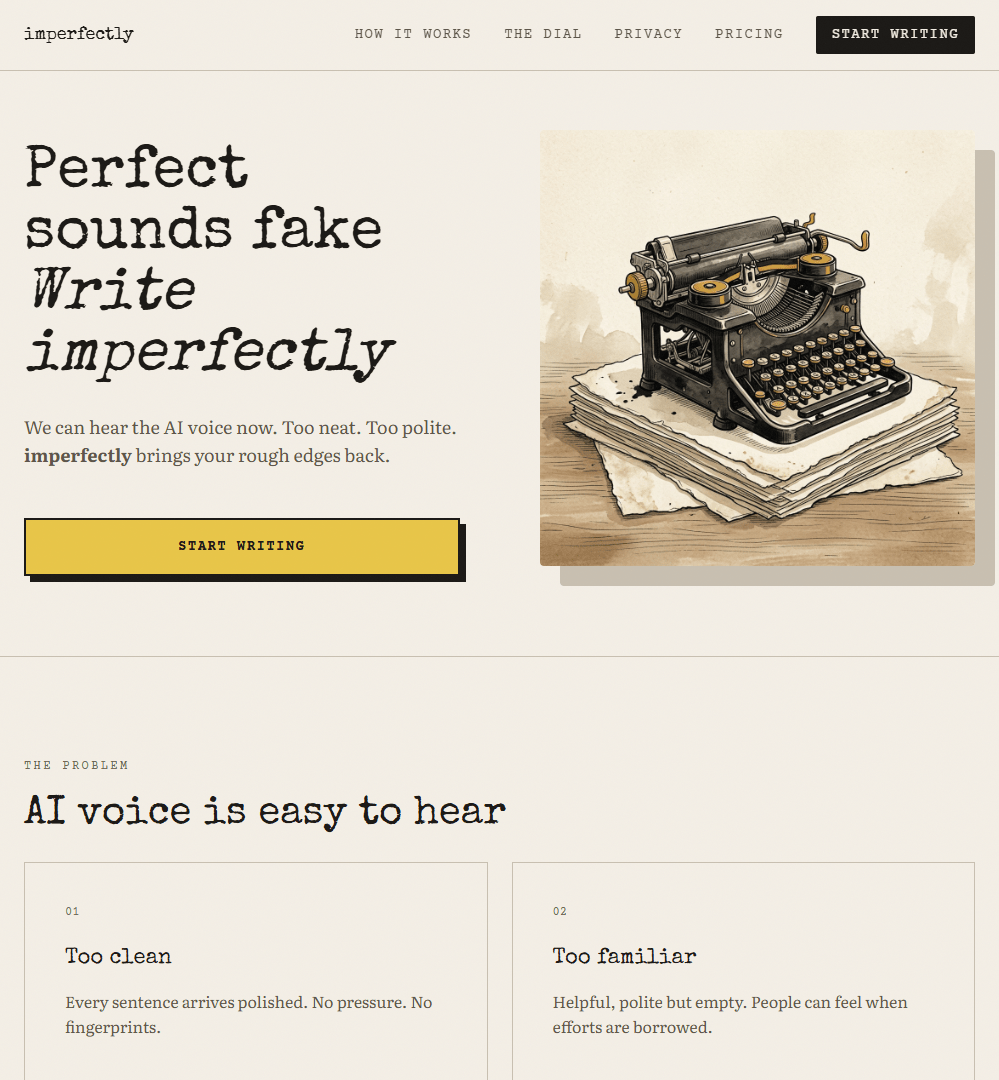
An anti-AI-slop writing tool — packaged in a hero / feature-cards / pull-quote / pricing-table / FAQ SaaS template that any AI would generate unprompted, decorated with a typewriter stock photo to signal authenticity, whose product logic is: AI writes too perfectly, so pay $9 a month to add the imperfections back.

Imperfectly sells a tool for making AI writing sound human. The site uses: hero, icon feature cards, pull quote, checkbox list, three-tier pricing, FAQ, footer CTA — the standard SaaS template under a sepia filter. The footer reads "Less AI slop. More you." The you in question is a you who paid to add errors to AI output.

Share this roast

PostShare

Score breakdown

Prompt residue7/10
Feature grid density7/10
Meaningless value prop7/10
Trust signal suspicion5/10
Founder face AI probability2/10
Product proof absence8/10
ShipFast resemblance8/10
Hero claim
"Perfect sounds fake. Write imperfectly." The claim is that AI writing is detectably too perfect, and the product corrects this. No benchmark, no detection methodology, no before/after showing the result. The hero is a typewriter photograph and a serif headline.
Proof problem
"Make it more imperfect" section shows a text editor UI with two text states but does not identify what changed or why the change passes as human. The product's value is invisible by design — you cannot screenshot "sounds less like AI." "Patterns, not secrets" section lists checkboxes whose content is obscured at hero scale. No usage metrics, no customer count, no case studies.
Visual pattern
Warm sepia-paper background throughout — notably not dark mode, a deliberate aesthetic departure from AI SaaS norms. Vintage typewriter photograph as hero image. Serif display headline. Two-column feature card section ("AI voice is easy to hear"). Icon card row ("Prompts are not enough"). UI demo section ("Make it more imperfect"). Full-width pull quote slab. Checkbox feature list ("Patterns, not secrets"). Three-tier pricing table (Free / $9 / $19). Accordion FAQ ("Quick answers"). Footer CTA: "Less AI slop. More you."
Why it still might convert
The product addresses a real and growing anxiety: content creators, professionals, and students who use AI assistance and are worried about detection or sounding robotic. That audience is large, embarrassed to discuss it publicly, and willing to pay $9 a month for plausible deniability. The sepia aesthetic is genuinely distinctive and the copy is sharper than the category average. The tool converts on fear, not proof — which is more effective than proof, and requires none.

Editorial roast

By Editorial Desk · Filed against imperfectly.app

¶ 01

Imperfectly.app sells a tool for making AI writing sound human. The homepage sells this using a hero with a tagline, feature cards with icons, a pull quote, a three-tier pricing table, a FAQ, and a footer CTA. A vintage typewriter photograph sits at the top to signal authenticity. The typewriter is a decoration. Beneath it, the page is the same template that an AI would produce if you asked it to design a SaaS landing page for a writing tool. The irony does not appear to be intentional.

¶ 02

The pull quote reads: "AI learned to write perfectly. People did not." This is the product's core argument, offered as a compliment to the buyer. It is also a confession: the AI is the better writer. The service being sold is the right to take credit for prose you did not write, with errors inserted afterward to make it seem as if you did. The product is not a writing tool. It is an alibi service.

An anti-AI-slop writing tool — packaged in a hero / feature-cards / pull-quote / pricing-table / FAQ SaaS template that any AI would generate unprompted, decorated with a typewriter stock photo to signal authenticity, whose product logic is: AI writes too perfectly, so pay $9 a month to add the imperfections back.

¶ 03

"Make it more imperfect" is a section heading above a UI demonstration. The demo shows a text editor with two states. The difference between them — what makes one "AI voice" and the other "more you" — is not explained. This is the product's central challenge: its value proposition is invisible. You cannot screenshot the absence of AI residue. The section below it is called "Patterns, not secrets." The patterns are not listed. The secrets are, presumably, in the $19 plan.

¶ 04

"Invest in your voice." Free. $9 per month. $19 per month. The voice being invested in is a corrected version of an AI's voice, which was trained on millions of human voices, and then adjusted by the product to reintroduce the specific imperfections the AI was trained to eliminate. The footer closes: "Less AI slop. More you." The page it closes consists of a hero, feature cards, a checklist, [redacted] a pricing table, and a FAQ. The you the footer promises is, structurally, not present anywhere on the page.

— 30 —

More from the archive

Similar offenders on file.

You are one funnel away from changing the world, and also one funnel away from your own signup form leaking a strangers email address into the placeholder text.

Open file →

Your ideas deserve more views, trusted by 14,000 plus creators worldwide, start for free — the same sticky banner, pinned to the bottom of every single section, saying the exact same thing no matter what you're looking at.

Open file →

An AI-powered tool for escaping AI guesswork — with a last-resort conversion section that tells you to go ask ChatGPT if it's worth buying.

Open file →

Correction channel

Wrong, unfair, or outdated?

Ask for a correction or update. Satire is more effective when the facts are not lazy.