Back to archivecertified generic

Case file — roast review

mador.aiRoast Review

ShitScore 49 / 100SEOCaptured 2026-11-02Submitted by communityVisit crime scene ↗

Five agents, fourteen assistants, fourteen sections, three plans, and your only job is to approve the work required to become an answer.

Mador measures whether AI assistants mention your business, shows who appears instead, and offers to write and publish the content you are missing. Unlike a lot of AI-visibility landing pages, it actually shows reports, workflows, geographic examples, and prices. It also turns being mentioned by a chatbot into a small administrative state: five agent jobs, fourteen platform sections, a leaderboard of competitors, and a premium plan that keeps the anxiety refreshed every week.

Share this roast

PostShare

Exhibit A — Evidence

Captured 2026-11-02

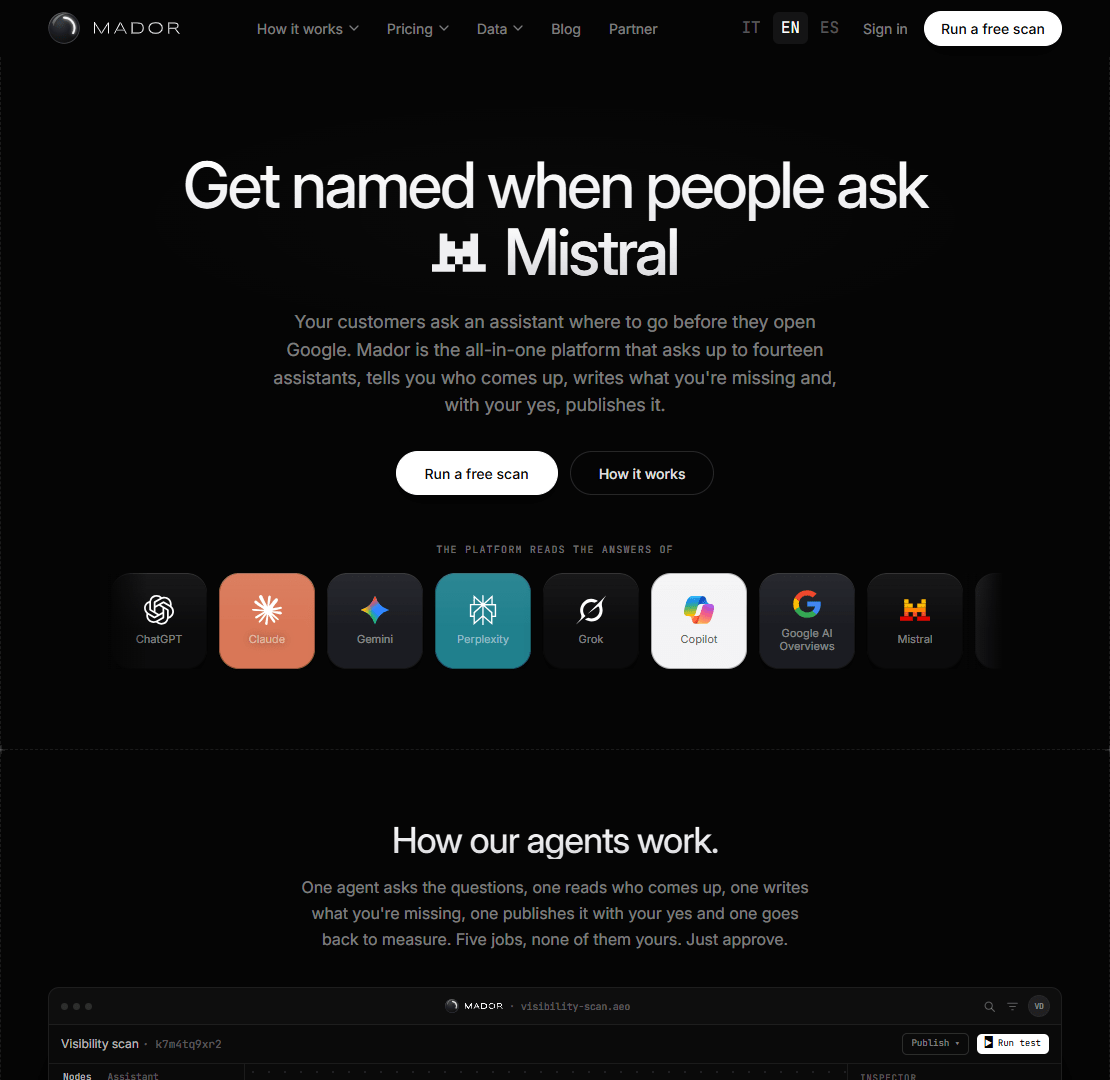
Mador homepage on black with the headline Get named when people ask Mistral, a free-scan button, ChatGPT, Claude, Gemini and other assistant logos, and the start of a How our agents work workflow preview.
Screenshot — mador.ai (1110×1080)
not a tool fourteen sectionsexact questions inferredchatbot recall leaderboardtwo twelve fourteen assistants

Score breakdown

Prompt residue7/10
Feature grid density8/10
Meaningless value prop5/10
Trust signal suspicion5/10
Founder face AI probability0/10
Product proof absence2/10
ShipFast resemblance7/10
Hero claim
Get named when people ask, captured with Mistral in the hero. The supporting copy describes asking up to fourteen assistants and writing and publishing missing content with approval.
Proof problem
The page provides substantial interface demonstrations, prices, and named measurement examples. Its weaker leap is treating modeled assistant queries as the exact questions actual customers ask, and competitor recommendations as evidence of customers being lost; the screenshot does not establish either attribution.
Visual pattern
Long near-black landing page with white rounded CTAs, assistant-logo tiles, node-based agent workflow, alternating text and report screenshots, measured-business logo chips, three benefit cards, three process columns, five paper-like metric tiles, agent badges, three tall pricing columns, add-on cards, geographic dot maps, and closing directory badges.
Why it still might convert
A local business can understand the free scan and see a tangible report before paying. The public product screens, explicit platform coverage, euro pricing, approval gate, and clearly labelled measured examples make this more credible than an abstract promise of AI visibility. Tracking recommendations over time can be useful even when it is not proof of customer acquisition.

Editorial roast

By Editorial Desk · Filed against mador.ai↗

¶ 01

The hero says "Get named when people ask" above Mistral, then explains an all-in-one platform that asks up to fourteen assistants, checks who appears, writes missing content, and publishes with approval. A few scrolls later it insists: "Not another tool. A team." The workflow editor has nodes, an inspector, agent labels, and a Run test button, while the copy promises "Five jobs, none of them yours. Just approve." Not another tool, just a team that arrives as fourteen sections of another tool.

¶ 02

The free-report section promises "The exact questions your customers ask" and tells you who is taking the customers who were looking for [redacted] you. The form asks for a business name, town, and category, with a website optional; those inputs can support useful local query research, but they do not demonstrate what an actual customer typed into an assistant. The page explains that Mador asks questions itself and reads the answers, which is a sensible visibility test rather than a transcript of lost business. A simulated recommendation is being promoted to a missing customer.

“Five agents, fourteen assistants, fourteen sections, three plans, and your only job is to approve the work required to become an answer.”

¶ 03

Credit where it is due: the logo row is titled "Businesses measured by the agents," rather than claiming these firms are customers. There are also visible report screens, named geographic areas, competitor tables, charts, and the promise to publish only with your approval. The sample report shows "5 of 120" times named, fourteen assistants, and a citations line climbing by 12.4%, giving the whole experience the atmosphere of a credit score for whether a chatbot remembers your restaurant. This is more inspectable than a generic AI-written search content pitch; it is also a very polished way to make answering a question feel like a league table you are losing.

¶ 04

The prices are refreshingly explicit: Scan at €0, Monitor at €59 per month, and Growth at €249 per month. The free scan asks ChatGPT and Perplexity; Monitor includes twelve assistants, while Growth reaches fourteen, adds weekly work, and supplies fifteen questions instead of six. Growth also lists a monthly "Book for me" test, a publication calendar, maps, and a coming-soon WhatsApp approval message, because apparently being recommended by an assistant requires the organizational overhead of running one. The first scan is free; the recurring product is finding out whether the robots still remember you.

— 30 —

More from the archive

Similar offenders on file.

An AI SEO agent whose main feature section is headlined "AI-generated content that feels human," demonstrated with example articles including "Top 5 Strategic Separator Tools or Separators."

Open file →

The distribution infrastructure for every site in this archive, submitting itself to the archive.

Open file →

A thread-discovery tool that finds relevant Reddit and Hacker News threads to reply to, whose hero instructs you to "Find them by hand" despite being an automated discovery product, whose ethical differentiator is the sentence "You reply. We never do." — meaning the product automates finding threads and leaves writing the reply entirely to you — and whose domain ends in .app.space.

Open file →

Correction channel

Wrong, unfair, or outdated?

Ask for a correction or update. Satire is more effective when the facts are not lazy.