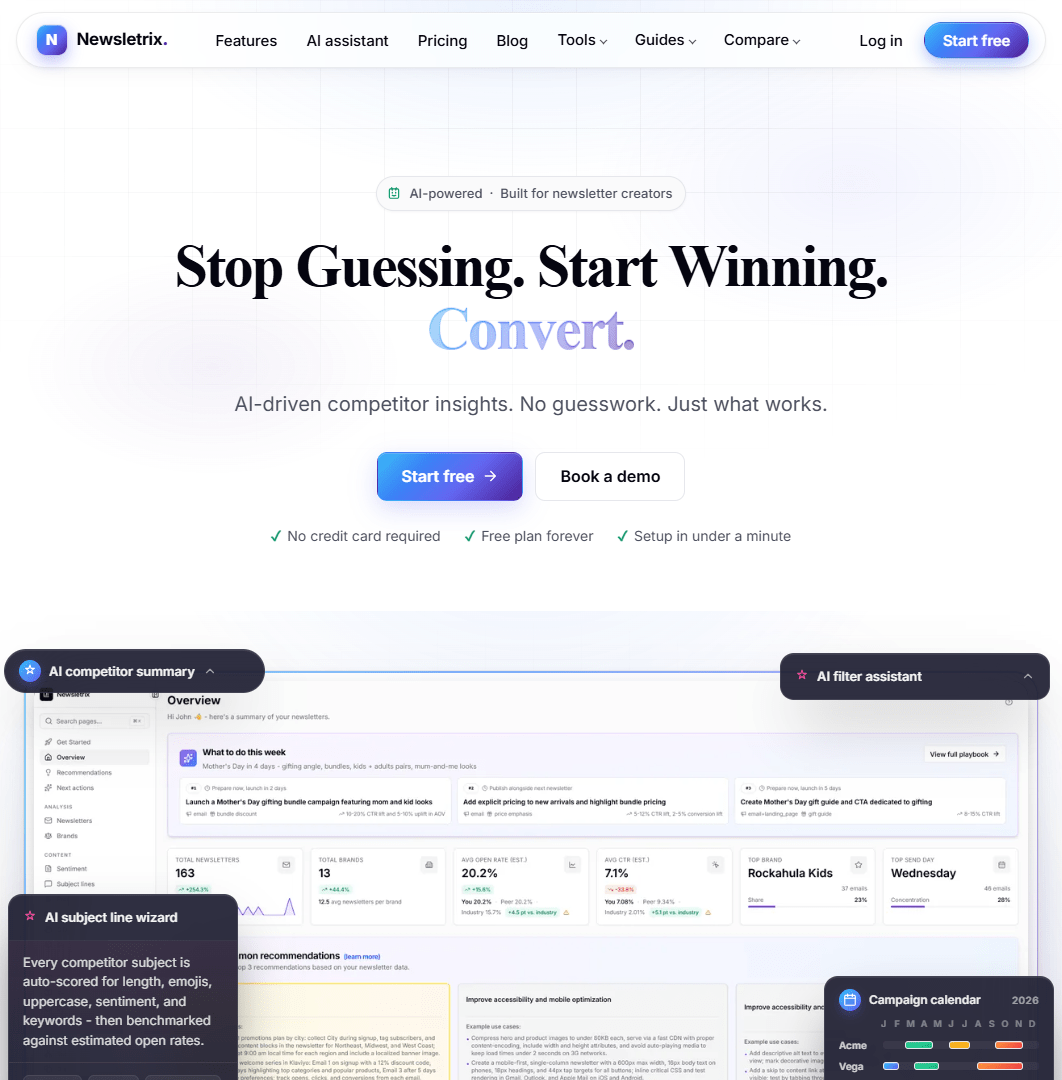
Proof problem"75% of newsletters fail due to this" — referent undefined, no source. Stat banner also shows "2+" and "50%" as isolated numbers. "What Users Are Saying" testimonials: three short quotes with first names only and vague role labels. Logo bar ("Works with newsletters from") lists Substack, Beehiiv, Mailchimp, ConvertKit, Klaviyo — these are platforms the product monitors, not integration partners or customers; framing them as a trust bar is misleading.Visual patternDark navy/indigo gradient hero. Eyebrow pill above H1. Centered Inter headline with orange accent word. Dashboard mockup. Logo trust bar. "Core Capabilities" label above eight-feature three-column icon-card grid (Recommendations, Subject Line Intelligence, Date & Time Distribution, Campaign Analysis & Forecast, CTA & Link Analysis, Strategic SWOT Analysis, Content Deep Dive & Keywords, AI Audience Context MCP). Dark stat banner: 75% / 2+ / 50%. Three-step numbered onboarding badges. "Who Benefits Most?" icon cards. Dark testimonials section. Pricing table (Free / $9 / $29 / $89). Comparison table (Newsletrix vs. manual analysis). FAQ accordion. Repeated CTA footer.Why it still might convertNewsletter competitive intelligence is a real, unsolved pain point — most newsletter operators have no systematic way to benchmark their send cadence, subject lines, or CTAs against competitors. If the SWOT and campaign analysis outputs are genuinely useful (not just AI summaries of obvious observations), the $9 Starter plan removes price as an objection entirely. The three-step onboarding framing is manipulative, but it is also accurate: connecting a Beehiiv or Substack account probably does take under two minutes. It converts because the problem is real even if the page is template-generated.