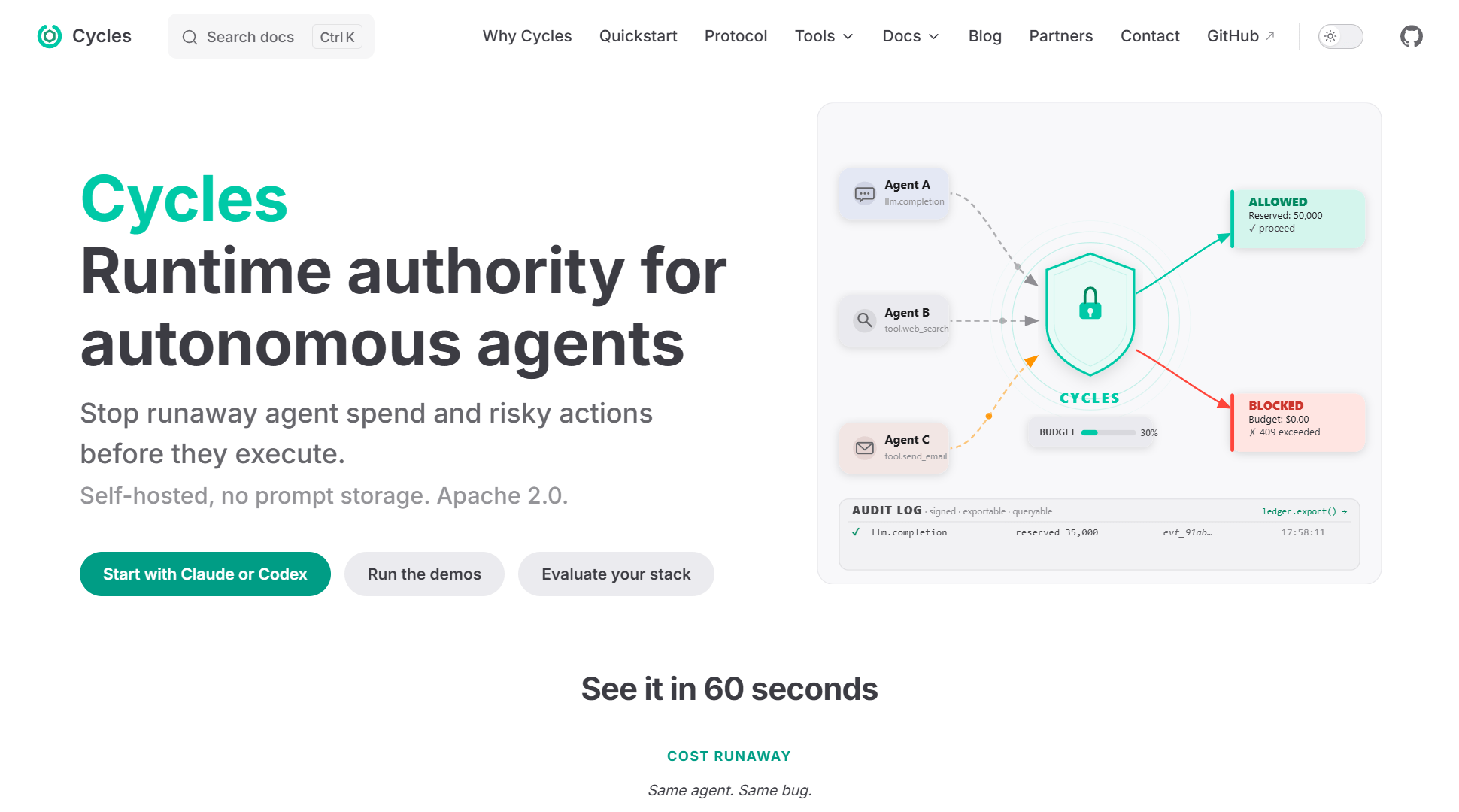
Proof problemGitHub stats shown: 24,484+ package installs, 70,782 repo clones — these are real and verifiable metrics. Incident cards use specific dollar amounts ($4,200, $1.40, $50K) that feel constructed for narrative clarity rather than sourced from actual incidents. The $1.40 / $50K ratio is too clean to be anecdotal. Integration logo wall includes 20+ tools (OpenAI, Anthropic, LangChain, Spring AI, AWS Bedrock, etc.) — all plausible integrations for a Python runtime library. Real code samples with working syntax.Visual patternWhite background, teal accent color throughout. Headline + architecture diagram split hero. Two terminal demo blocks (cost runaway and blast radius) with side-by-side without/with comparisons. Four incident horror-story cards in a 2x2 grid. Integration logo wall (20+ logos, two rows). Code snippet section. Eight documentation tiles in a 4x2 grid. Five-step onboarding progression. Four-reason contact section with founder claim and GitHub redirect. Minimal footer.Why it still might convertThe product is technically real, open-source (Apache 2.0), and self-hosted — which removes the vendor trust barrier entirely. The GitHub stats (70K+ repo clones) suggest genuine adoption. The decorator pattern is low-friction to adopt: one import, one annotation. The incident cards are persuasive because the scenarios they describe ($4,200 loops, shared budget exhaustion, prompt injection damage) are real failure modes that practitioners have actually hit. It converts because the problem is real, not because "runtime authority" is an inspiring phrase.